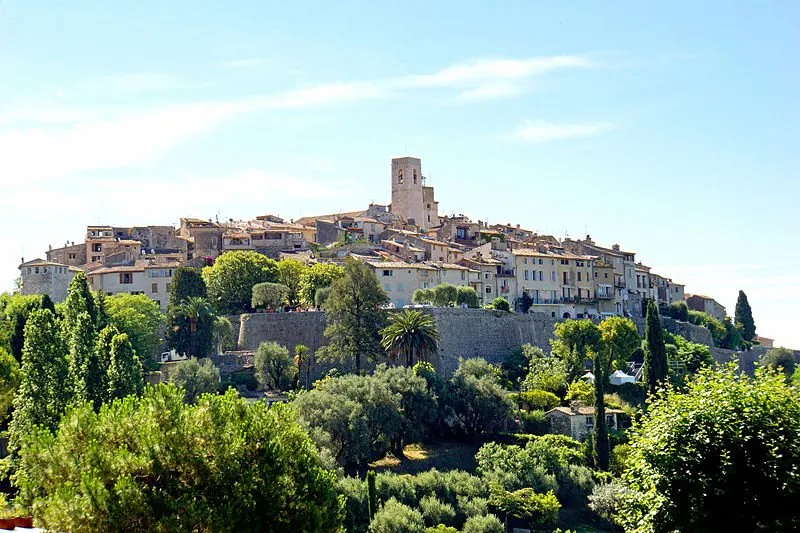
At half past eight, the sea at Cap-Ferrat still has the colour of polished metal. An hour later you are in the hills above Vence, where Matisse and Chagall lived and where the Fondation Maeght brings together Giacometti, Miró and Braque. This day links the places that tell that story, without rushing and with room left for lunch.
The spirit of the outing
Cap-Ferrat looks out to sea; Vence and Saint-Paul-de-Vence look towards the light. Less than an hour’s drive separates these two Rivieras, and it is the contrast that makes the day interesting: from gardens facing the sea to a hilltop village, from Belle Époque villas to a bare white chapel.
Matisse worked on the Chapelle du Rosaire from 1947 to 1951 and regarded it as his masterpiece. Chagall stayed in Vence from 1950 to 1966 and in 1979 signed, for the town’s cathedral, his last mosaic made in his lifetime. The Fondation Maeght, designed by the architect Josep Lluís Sert, opened in Saint-Paul-de-Vence in 1964 so that the works, the building and the garden would answer one another. That conversation is what you come for.
The itinerary, hour by hour
The plan assumes a 9 a.m. departure and a chauffeur who stays with you or comes back to collect you. Times are approximate and vary with traffic, which is heavier in summer on the coastal roads and towards Vence.
9 a.m. – On the road to Saint-Paul-de-Vence
Allow 50 minutes to 1 hour from Cap-Ferrat, via Nice and the A8 as far as Cagnes-sur-Mer, then the road to Vence.
10 a.m. – The Fondation Maeght
According to the official website, the Fondation is open every day from 10 a.m. to 6 p.m. (until 7 p.m. in July and August), closing exceptionally at 4 p.m. on 24 and 31 December. Tickets are sold on site or online, and booking is not compulsory. Arriving at opening time lets you walk through the Giacometti courtyard, Miró’s labyrinth and the sculpture garden before the groups arrive.
Inside, the collection includes works by Braque, Chagall, Léger and Calder, among them Chagall’s La Vie (1964). New 500 m² galleries, opened in July 2024 by the architect Silvio d’Ascia, have been slipped beneath the Miró and Giacometti courtyards: they cannot be seen from outside. Allow about an hour and a half to two hours for the visit.
12.15 p.m. – Lunch in Saint-Paul-de-Vence or Vence
The village of Saint-Paul is explored on foot: the car stops at the entrance. The terrace of La Colombe d’Or, where, according to tradition, artists once paid for their meals with their works, remains the village’s best-known table. It is much in demand: have the concierge book it and confirm that it is open for the period you have chosen. Vence, about ten minutes away, also has tables in its old town, around the Place du Peyra.
2.15 p.m. – Matisse’s Chapelle du Rosaire
On the edge of Vence’s old town, the chapel is Matisse’s last great project. He designed the building, the stained glass and the ceramic wall panels for the Dominican sisters of Vence. Inside, light passes through blue, green and yellow windows and falls on black drawings traced on white tiles: Saint Dominic, the Virgin and Child, the Stations of the Cross.
The chapel’s opening hours are the first thing to check. It is not open every day, its slots change from one period to another, and it closes every year in late autumn: in 2026, from 16 November to 7 December inclusive according to the tourist offices consulted. Early afternoon is the most regular slot, but closing comes early, around 4.30 p.m. depending on the period. Ask also about the conditions of visit, in particular for photography.
3.30 p.m. – Vence’s old town and Chagall’s mosaic
In the old town, the Cathedral of Notre-Dame de la Nativité houses in its baptistery Moses Saved from the Waters, Chagall’s 1979 mosaic, made when he was 92. Allow a little under an hour with the lanes and the Place du Peyra, and check the cathedral’s opening times on the day.
5 p.m. – Back to Cap-Ferrat
The return takes about an hour, longer on busy days. Dinner at the hotel, or a walk on the Cape before nightfall if the weather allows.
Extending your stay at Cap-Ferrat
The next morning, the Villa and Gardens Ephrussi de Rothschild are a few minutes from the palace hotels on the cape: a Belle Époque palace surrounded by nine themed gardens (French, Spanish, Florentine, lapidary, Japanese, exotic, Provençal, rose garden and Sèvres garden), with a restaurant and tea room. Opening hours and seasonal events are shown on the villa’s official website.
Who this outing is for, and when to go
- Travellers curious about modern art, who have already seen the coast and want something other than the Croisette or Monaco.
- Family stays: the Fondation Maeght runs workshops for children, whose dates should be checked.
- Year-round, with two reservations: the chapel closes in autumn, and in July and August the villages are very busy, which argues for arriving at opening time. In spring and autumn, the temperatures make walking in the villages more pleasant.
Conclusion
On the way back, Cap-Ferrat looks a little different. The Riviera is not just its shoreline: less than an hour’s drive away, it keeps the studios, chapels and foundations that made 20th-century art history. To extend your stay by a day or two, see our article on Saint-Paul-de-Vence or our day between Èze, Villefranche and Cap-Ferrat.
Sources consulted in November 2026: official websites of the Fondation Maeght and of the Villa Ephrussi de Rothschild, Nice Côte d’Azur Tourist Office for the Chapelle du Rosaire, City of Vence for the cathedral. Opening hours and openings are subject to change: check them before you leave.
This blog is published by Vehira, a VTC (chauffeur-driven vehicle) company. Links to maison-vehira.fr lead to our website. Information checked in November 2026; journey times are indicative and vary with traffic.