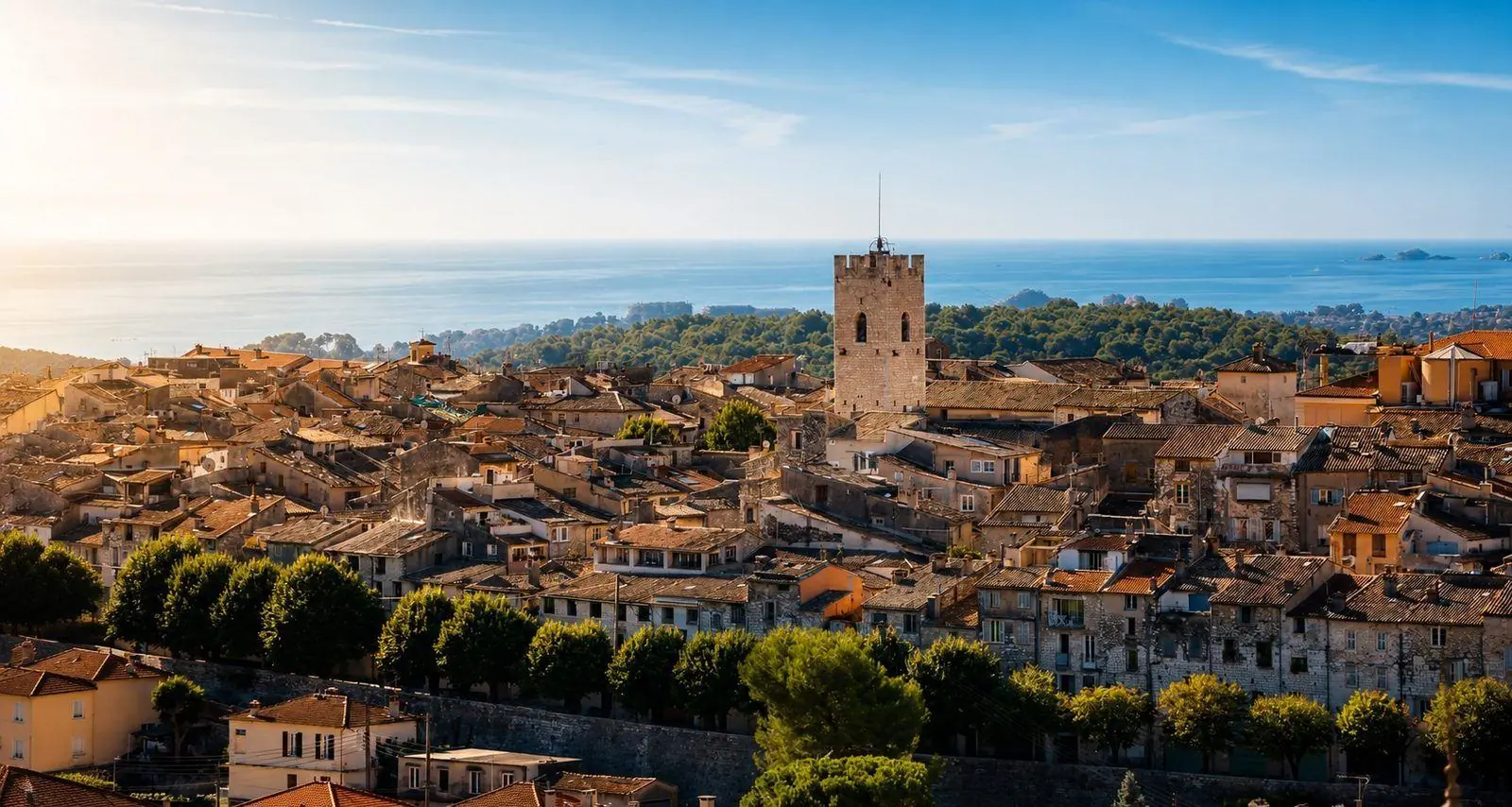
Between sea and mountains, some twenty kilometres from Nice, Vence is a Roman city that became a bishopric and then a refuge for artists. Here are the main landmarks of its history, according to the sources consulted, and what you can see in the old town and around it.
From Vintium to the bishopric
Vence is the former Roman city of Vintium, founded by the Ligurians. It was first under the control of the Nerusii tribe, before the conquest by Augustus and the creation of the province of the Maritime Alps in the last quarter of the 1st century BC. From the Christian era it was the capital of a civitas.
A bishopric is attested there in the 5th century: the first confirmed bishop is Severus, from 419 to 442. The present cathedral dates, in its current form, from the 11th and 12th centuries. Among the bishops, Saint Lambert (1084-1154), a monk of Saint-Honorat de Lérins, remains one of the best known.
The old town
The ramparts of Vence were built in 1231. The heart of the town is organised around place du Peyra, a forum in the Middle Ages, with its fountain, and place Clemenceau. Curiosities mentioned include an ash tree planted in 1538 and given by Francis I, the Roman columns (known as the Marseillais columns), the White Penitents’ chapel (1614) and the Saint-Martin commandery. The commune has twenty-five fountains in all, including those of La Foux.
Matisse and the artists
The Rosary Chapel, designed by Henri Matisse, was consecrated on 25 June 1951; its first stone had been laid on 11 December 1949. Vence also welcomed other artists and writers, among them Raoul Dufy, Marc Chagall and D. H. Lawrence. The Château de Villeneuve houses the Fondation Émile-Hugues. Opening days and hours of the chapel and cultural venues change: check them before you go.
At the foot of the mountains
The commune ranges from 40 to 1,033 m in altitude. Above the town, the Col de Vence and the Baous (Baou des Noirs, Baou des Blancs) open onto mid-mountain landscapes.
Who this article is for, and when to reread it
- History enthusiasts, from the Roman city to the bishopric.
- Art lovers, preparing for Matisse’s chapel.
- Before each visit: opening times of cultural venues change.
Conclusion
Roman city, bishopric, Matisse’s village: Vence packs twenty centuries of history into an old town best explored on foot.
Sources consulted on 28 November 2026: Vence, Wikipedia (French). Cover photo: Maison Vehira (Vence).
This blog is published by Vehira, a VTC (chauffeur-driven vehicle) company. Links to maison-vehira.fr lead to our website. Information checked in November 2026; journey times are indicative and vary with traffic.